
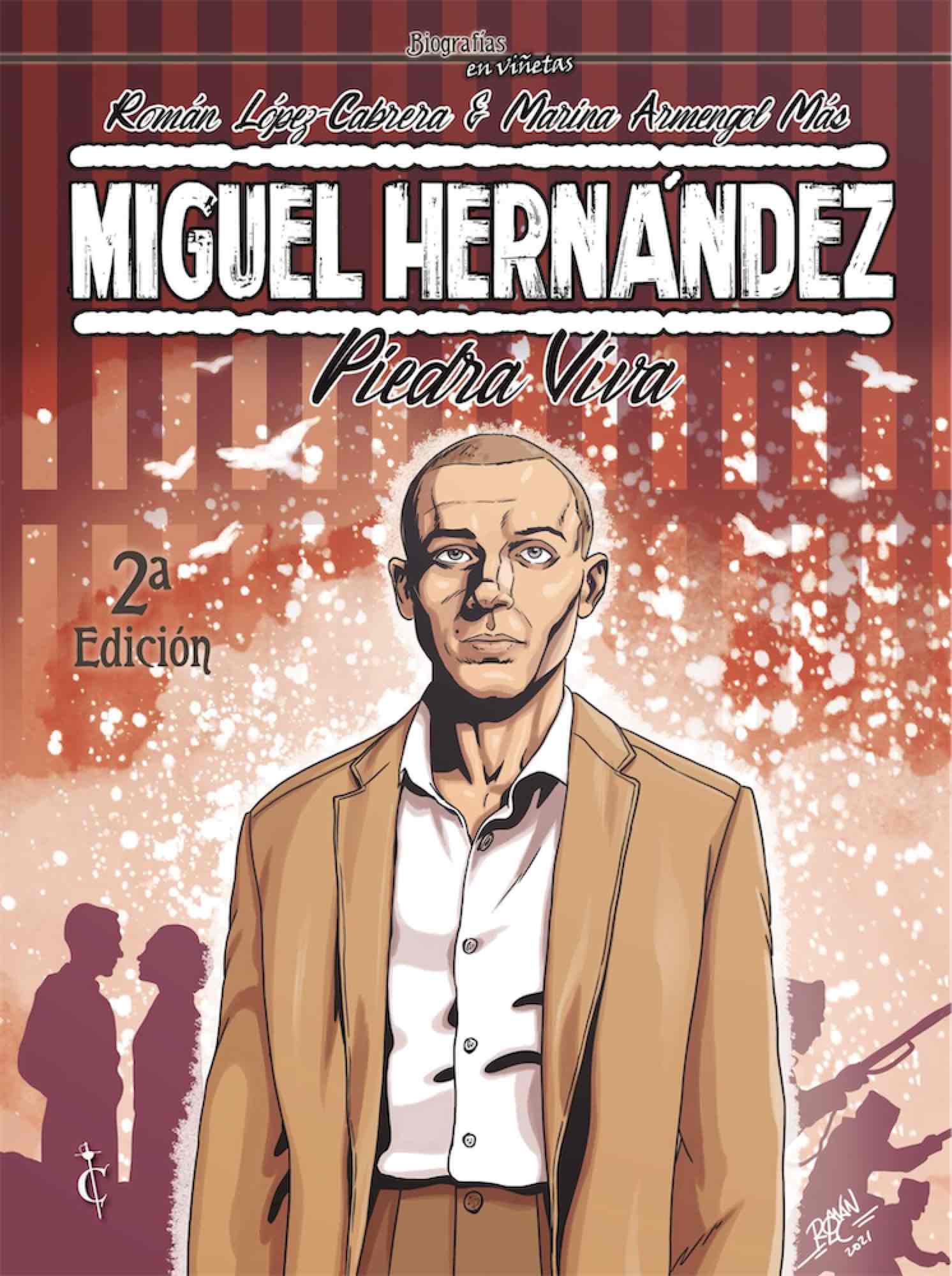
Título:
Miguel Hernández. Piedra Viva.
Colección:
Biografías en Viñetas.
Autor:
Román López-Cabrera.
Color:
Román López-Cabrera &
Marina Armengol Más.
Prólogo:
José Luis Ferris.
Epílogos:
Aitor L. Larrabide & José Carlos Rovira.
Correccion:
Ana Doménech García.
Maquetación:
Daniel Torrado.
Editado por:
Cascaborra Ediciones.
Páginas: 118.
Primera edición:
20 de mayo de 2021.
Segunda edición:
Marzo de 2022.
ISBN: 9788409301829
Depósito Legal: B 8638-2021
*Esta obra ha recibido una ayuda a la edición del Ministerio de Cultura y Deportes.
COMPRAR:
https://www.todostuslibros.com/libros/miguel-hernandez-piedra-viva_978-84-09-30182-9
Title:
Miguel Hernández. Piedra Viva.
Collection:
Biografías en Viñetas.
Author:
Román López-Cabrera.
Color:
Román López-Cabrera & Marina Armengol Más.
Foreword:
José Luis Ferris.
Epilogues:
Aitor L. Larrabide & José Carlos Rovira.
Text correction:
Ana Doménech García.
Layout:
Daniel Torrado.
Published by:
Cascaborra Ediciones.
Pages: 118.
First Print:
May 20, 2021.
Second Print:
March, 2022.
ISBN: 9788409301829
Legal Deposit: B 8638-2021
*This work has received an aid to the edition of the Ministry of Culture and Sport.
BUY:
https://www.todostuslibros.com/libros/miguel-hernandez-piedra-viva_978-84-09-30182-9
SINOPSIS:
En 1910 nacía en Orihuela Miguel Hernández Gilabert; tras unos años de estudios en el colegio jesuita de Santo Domingo, su padre decidió que sería más útil cuidando el rebaño de cabras de la familia. Pero Miguel entendió muy pronto que su destino era escribir versos y teatro. Con esa determinación empezó una larga lucha por hacerse un hueco en el panorama literario del Madrid de los años treinta, hasta lograr codearse con nombres de la talla de Pablo Neruda, Vicente Aleixandre, Maruja Mallo, Rafael Alberti o Federico García Lorca. Por el camino descubrió el amor y, tras varios desengaños amorosos, sería con Josefina Manresa con quien acabaría casándose.
Miguel, que había sido criado en el entorno cultural-eclesiástico de la Orihuela de la época, fue descubriendo otras formas de pensar tras su integración en el ambiente madrileño y, al comenzar la Guerra Civil, tomó partido y compromiso con la República y con el Partido Comunista, convirtiéndose en uno de los principales poetas del período bélico y llegándose a ganar los apelativos de Poeta de la Revolución o Poeta del Pueblo.
En 1939, acabada la guerra, fue detenido y allí empezó un cruel periplo carcelario por diez prisiones hasta su muerte tres años después, sin renunciar jamás ni bajo ninguna circunstancia a sus ideales de libertad.
SYNOPSIS:
In 1910 Miguel Hernández Gilabert was born in Orihuela; after a few years of study at the Jesuit college in Santo Domingo, his father decided he would be more useful looking after the family’s herd of goats. But Miguel soon understood that his destiny was to write verses and plays. With that determination began a long struggle to gain a foothold in the literary scene of Madrid in the 1930s, until he managed to rub shoulders with names of the stature of Pablo Neruda, Vicente Aleixandre, Maruja Mallo, Rafael Alberti or Federico García Lorca. Along the way he discovered love and, after several love disappointments, it would be with Josefina Manresa that he would end up marrying.
Miguel, who had been raised in the cultural-ecclesiastical environment of Orihuela at the time, gradually discovered other ways of thinking after his integration into the Madrid environment and, when the Civil War began, he took sides and committed himself to the Republic and to the Communist Party, becoming one of the main poets of the war period and earning the titles of Poet of the Revolution or Poet of the People.
In 1939, after the war, he was arrested and there began a cruel prison journey through ten prisons until his death three years later, without ever giving up his ideals of freedom under any circumstances.